 Qarote
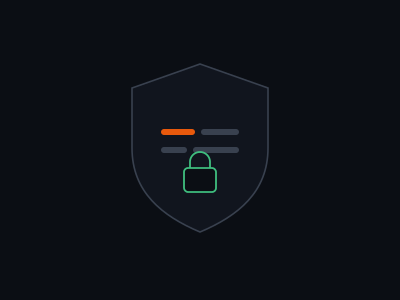 offline jwt
Validating licenses offline, with no phone-home

If you run software in an air-gapped network, “just call our license server” is a non-starter. Plenty of self-hosted tools quietly phone home to verify entitlement — a heartbeat, a periodic check-in, a license ping. Each one is a connection your security team has to reason about and, often, refuse. Qarote’s licensed edition validates entitlement entirely offline. Nothing leaves your network, ever.
The problem with phone-home
Online license checks fail in exactly the environments that need self-hosting most. Air-gapped clusters can’t reach the internet by design. Security-conscious teams treat every outbound connection as attack surface and audit it accordingly. And a vendor’s license server is a single point of failure: if it’s down, does your monitoring stack stop working? For an ops tool, that’s unacceptable — the thing that watches your brokers can’t depend on someone else’s uptime.
The fix is to make the license self-verifying, so the check needs no network at all.
Signed JWTs, verified locally
A Qarote license key is a JSON Web Token (JWT). It carries the entitlement claims — tier, expiry, seat scope — and it’s signed with a private key that only we hold. Qarote ships with the corresponding public key baked into the binary.
Verification is pure local cryptography:
- Parse the JWT from the license key.
- Verify its signature against the baked-in public key.
- If the signature is valid, trust the claims inside it.
Asymmetric signing is what makes this safe. The public key can only verify a signature — it can’t create one. So shipping it inside every binary gives away nothing; a forged license would need the private key, which never leaves us.
license key (JWT)
  ├─ header   { alg: "EdDSA" }
  ├─ payload  { tier: "enterprise", exp: 1780000000, ... }
└─ signature ← verified against baked-in public key, offlinePublic-key crypto is the whole trick: the key we embed can confirm a license is genuine but can’t mint a new one. That’s why the check works with zero network and still can’t be faked.
What this buys you
Because verification is offline and deterministic, a few good properties fall out:
- Nothing leaves your network — no heartbeat, no check-in, no telemetry tied to licensing. Your egress firewall stays closed.
- Air-gapped works the same as connected. The validation path is identical whether the box can reach the internet or not.
- No vendor dependency at runtime. Our infrastructure being up or down has no bearing on whether your monitoring runs.
Offline signing means a JWT is valid until it expires — there’s no revocation call to reach a disconnected box. Expiry lives in the token’s claims, so renewals ship as a new key. (Qarote also offers an online, DB-validated key for teams that want revocation; the offline JWT is the air-gap-friendly path.)
The principle
Entitlement is a math problem, not a network problem. A signature either verifies against the public key or it doesn’t, and that question can be answered on a machine that has never seen the internet. For air-gapped and security-conscious teams, that’s the difference between “we can run this” and “legal said no.”
Building agent-native RabbitMQ diagnosis. Previously spent too many on-call nights staring at queue charts — which is roughly why Qarote exists.
Try it on your own broker.
Connect in under two minutes, wire your agent, and ask it what's wrong.