 Qarote
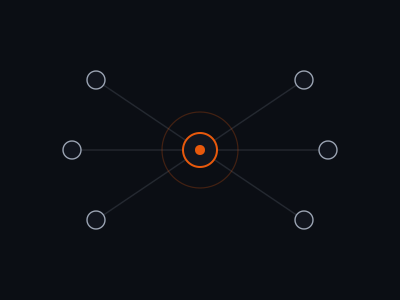 + any client
One MCP surface, every client: Cursor, Copilot, Codex

Qarote exposes one MCP surface — list_incidents, get_incident, explain_finding, and the config-scan tools. Any MCP-capable agent can call it. The tools are identical no matter who’s asking; the only thing that changes is where each client keeps its server config.
Same tools, five clients
The endpoint and the API key are the same everywhere. Point the client at https://your-qarote.example.com/api/mcp, pass the key, and ask “what’s wrong with my rabbitmq?”. Where you put that config is the only per-client wrinkle:
- Cursor —
~/.cursor/mcp.json(global) or.cursor/mcp.jsonin the project. - GitHub Copilot —
.vscode/mcp.jsonin the workspace, under aserversblock. - Codex — the CLI’s
~/.codex/config.toml, as an[mcp_servers.qarote]table. - Windsurf —
~/.codeium/windsurf/mcp_config.json. - opencode — the
mcpblock inopencode.json.
The config, give or take a key name
Most of these clients share the JSON shape Claude Code uses. Here’s the Cursor/Windsurf/opencode form:
{
  "mcpServers": {
    "qarote": {
      "type": "http",
      "url": "https://your-qarote.example.com/api/mcp",
      "headers": { "Authorization": "Bearer ${QAROTE_API_KEY}" }
    }
  }
}
Copilot uses servers instead of mcpServers. Codex uses TOML rather than JSON but carries the same three facts — url, transport, auth header.
The differences are cosmetic — a key name here, a file path there. None of them change the tools, the responses, or the diagnosis. Pick the client you already work in; Qarote answers the same question from all of them.
Why a single surface matters
One surface means one thing to secure, one key to rotate, and one mental model to teach. Whether your team lives in Cursor, Copilot, Codex, Windsurf, or opencode, they’re all hitting the same deterministic detection and the same on-demand explain_finding. The agent is interchangeable; the diagnosis is not.
Building agent-native RabbitMQ diagnosis. Previously spent too many on-call nights staring at queue charts — which is roughly why Qarote exists.
Try it on your own broker.
Connect in under two minutes, wire your agent, and ask it what's wrong.