 Qarote
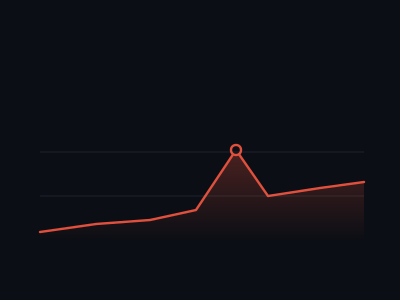 depth ↑
Reading a depth anomaly: signal vs planned drain

A queue depth chart pointing up is the most over-paged signal in messaging. Sometimes it’s an outage. Just as often it’s a replay you kicked off yourself, or a batch job behaving exactly as designed. A rule that fires on “depth went up” will cry wolf until you mute it — and then miss the real one. The skill is telling the two apart.
Climbing isn’t the same as broken
Depth is a derivative of two flows: publish rate in, ack rate out. Depth rises whenever publishes outpace acks, and there are two completely different reasons that happens:
- A real backlog — consumers can’t keep up, or aren’t there at all. Drain rate is at or near zero while messages pile in.
- A deliberate drain or replay — you intentionally pushed a burst, and consumers are chewing through it as fast as they can.
Same chart. Opposite meanings. The number on the y-axis can’t distinguish them; only the shape of the surrounding signals can.
What the rules engine weighs
Qarote’s rules engine doesn’t fire on depth alone. It reads the supporting signals and asks whether they describe loss or load:
- Consumer count and delta. Did consumers drop right before depth climbed? Loss looks like an incident. A stable or rising consumer count under a publish spike looks like planned load.
- Drain rate. Near-zero ack rate while depth grows is the backlog tell. A healthy ack rate that simply can’t match an unusual publish burst is a drain in progress.
- Publish shape. A sharp, bounded spike consistent with a replay or batch reads very differently from a steady climb with no end.
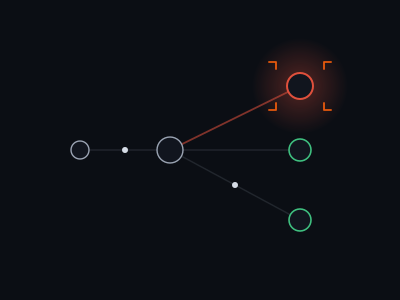
- Co-firing. Are sibling queues degrading at the same time? Correlated loss points at a shared cause; an isolated climb on one queue points at that queue’s own workload.
The question is never “is depth high?” It’s “is anything draining it?” A deep queue with healthy consumers and a falling slope is a drain doing its job. A shallow queue that just lost every consumer is the one to wake up for.
So the page means something
By gating on the combination — consumers lost and drain stalled and, ideally, co-firing siblings — the engine fires when depth signals a genuine problem and stays quiet when it’s you running a replay. That’s the difference between an alert you trust and one you’ve trained yourself to ignore.
Building agent-native RabbitMQ diagnosis. Previously spent too many on-call nights staring at queue charts — which is roughly why Qarote exists.
Try it on your own broker.
Connect in under two minutes, wire your agent, and ask it what's wrong.